
2026 BEI National Conference - registration is open. Secure your spot today.

Navigating Psychological Forces in Business Exits: Insights for Professional Advisors

In the realm of business exits, understanding the psychological mindset of business owners is paramount for professional advisors. Many times the aversion or hesitations advisors perceive from their owner clients have far deeper explanations that are worth consideration. From when and how to approach the conversation, to determining what services might benefit them most, there are a lot of considerations when entering into a planning engagement. Have you been faced with any of the following factors? If so, what advice can you share with us? 

Click here to download the guide below to learn tips on engaging owners before, during, and after their business transition!

Owners embarking on the journey of exiting their businesses by way of sale, insider transition, ESOP, or an alternate path, are often influenced by a myriad of psychological forces that can significantly impact their decisions and behaviors throughout the process. Recognizing these forces and knowing how to navigate them can greatly enhance an advisor’s ability to guide their clients towards successful exits. Let’s explore a few of these forces in more detail below. 

Fear of Loss: 

One of the most potent psychological forces influencing business owners contemplating an exit is the fear of loss. Owners haven’t only invested their money, they’ve committed their time, effort, and emotions into  building their businesses. The prospect of letting go of their business can trigger anxiety and uncertainty about the future. 

Advisors need to acknowledge and address these fears by providing reassurance, offering realistic assessments of potential outcomes, and highlighting the opportunities that lie beyond the exit. Many times, owners have not even begun to envision what their post-exit lifestyle could look like if they take the necessary planning steps ahead of time. 

Emotional Attachment: 

Businesses are often intertwined with the personal identities of their owners. Letting go of a business can feel like relinquishing a part of oneself. Emotional attachment can cloud judgment and lead to irrational decision-making. 

Professional advisors should approach these situations with empathy, understanding the emotional significance of the business to the owner. They can help owners detach emotionally by focusing on the strategic aspects of the exit and emphasizing the potential for personal growth and new opportunities.

Risk Aversion: 

Many business owners are naturally risk-averse, especially when it comes to significant changes like exiting their businesses. The fear of the unknown and concerns about financial stability can cause owners to hesitate or resist discussing the exit process. 

Advisors can mitigate this by providing comprehensive risk assessments, exploring alternative exit strategies, and implementing risk mitigation strategies such as contingency plans, incentive planning, and financial safeguards.

https://exitplanning.com/event/bei-strategies-for-success-using-phantom-stock-incentive-planning-to-exceed-goals-and-roi
Register for an upcoming webinar at the above link where a case study will be reviewed detailing the success an owner had post-exit after implementing risk mitigation strategies.  

Overvaluation: 

Owners often have an inflated sense of the value of their businesses, which can hinder the exit process. Unrealistic expectations regarding valuation can lead to negotiations breaking down or deals falling through. Overvaluation can also provide for an unforeseen gap to present itself to the owner between what they actually have and what they need in order to provide for their desired post-exit lifestyle. 

Professional advisors play a crucial role in managing these expectations by conducting thorough and accurate valuations, educating owners about market realities, and guiding them towards realistic valuation targets. Clear communication and transparency are essential in aligning expectations with market realities.

Loss of Purpose:

For many business owners, their entrepreneurial ventures are not just about financial gain but also about fulfillment and purpose. Exiting the business can leave them feeling adrift and purposeless, especially if they are also exiting the workforce too.

Advisors can help owners navigate this existential transition by facilitating discussions around life goals, values, and personal aspirations. Encouraging owners to envision the next chapter of their lives and explore new avenues for fulfillment can ease the emotional burden of exiting the business.

Conclusion

In conclusion, understanding and addressing the psychological forces at play in business exits is essential for professional advisors seeking to guide their clients towards successful outcomes. By recognizing the fears, emotions, and biases that influence owners’ decision-making processes, advisors can tailor their strategies and interventions to support owners effectively through every stage of the exit journey. 

Through empathy, expertise, and strategic guidance, advisors can empower owners to navigate the complexities of business exits with confidence and clarity. A recent presentation by Dr. Allie Taylor of Clearwater Insights, LLC, shared that there is tremendous power in working with an owner’s natural inclinations, which are oftentimes viewed as resistance, rather than against them.

To watch the recording of Dr. Taylor’s presentation that expands on this topic of psychological forces in owners, follow the link below.


https://exitplanning.com/webinars/?wchannelid=sw5zip1zi8&wmediaid=mhthkb9rv9

Engaging Successful Business Owners is Easy!

It’s hardly news that that the most attractive market for your financial and insurance services and products are successful business owners. Yet, it can be difficult to attract and engage these owners as clients because they are laser-focused on their businesses. These owners are often deeply immersed in the day-to-day operations, strategic planning, and decision-making processes of their businesses. To effectively engage owners, financial and insurance advisors must approach owners through methods that recognize the specific needs and constraints of successful business owners.

In order to engage owners in planning, you must use an approach with owners that aligns what you have to offer with what owners want: To grow and protect their businesses. Owners are far more willing to meet and engage with you if you can demonstrate how you can help them. Is that something you are doing effectively today?

It might be obvious that a process called “Owner-Based Planning” would do precisely that: Help owners do what they want to do by growing and protecting cash flow and business value. What isn’t so obvious is that financial and insurance advisors trained in Owner-Based Planning more effectively engage more business owners clients than those who are not. But to work with more owners, you need to change or alter your approach to attracting and engaging them.

In this blog, we’ll cover how utilizing Owner-Based Planning can help.

A New Approach to Engaging Business Owners

At BEI, we are firm believers in the effectiveness of targeted marketing and client engagement, which entails delivering the appropriate messages to the right individuals with consistency, and then delivering customized solutions to your prospects. For owners, their time is a precious commodity, and they are highly selective about how they use it. That’s why we’re providing you with a three-step approach to connect with owners.

Step One:  Focus your marketing on providing information about how to grow and protect value. Clearly articulating the value of your offerings and the efficiency of your services is essential to capturing owners’ attention.

Our Owner-Based Planning Advisors use brandable newsletters (“Business Briefs”) whose topics include:

  • When Business Value Stalls
  • All Business Value is Not Equal
  • Using Owner-Based Planning to Build Business Value

Our Advisors also use brandable white papers that describe in greater detail topics like using value drivers to increase the value of a company and filling gaps in business continuity plans.

Our marketing tools and resources seldom mention life insurance or investment planning. Instead, the emphasis is placed on the ways owners can build and safeguard the value of their businesses – a topic that universally captures the interest of all owners.

Step Two: Help owners identify and prioritize their company-related concerns or challenges using a software-based Assessment. Common challenges include developing and retaining management, growing cash flow, and involving family in ownership.

Step Three:  Address the concerns identified in the Assessment. We’ve created over 30 recommendations for action designed to address various owner challenges. Nearly all of them require the purchase of one of your products or services. These tailored solutions are not only a critical component of attracting and engaging successful business owners, but also reinforce the necessity of your firm’s products in growing and protecting their business.

Once owners understand that you—unlike your competitors—have the expertise and tools to help them grow and protect business value, engaging them is that easy.

https://exitplanning.com/event/bei-strategies-for-success-using-phantom-stock-incentive-planning-to-exceed-goals-and-roi

Championship Advisor Teams: A Super Bowl Strategy for Exit Planning

It’s Super Bowl Weekend! As the San Francisco 49ers get ready to take on the reigning champs in the Kansas City Chiefs, business owners around the country are looking to exit their businesses, but might not have the right resources to reach all of their goals at the time of their exit.

For each team playing on Sunday, it’s taken grit, perseverance, and hard work to be able to perform on the biggest stage in sports. It’s no different for business owners, who dedicate their lives to something they believe in. Just as professional sports organizations carefully select each player when developing a championship-caliber team, assembling an advisor team for business Exit Planning is an essential process for generating exit success.

Every business owner’s exit strategy is as unique as the teams that compete for the Super Bowl, with specific financial goals, values, and timelines. Leaving a business carries countless implications that affect more than just the business owner: For instance, an owner looking to exit their business needs to consider whom he or she will transfer the business to; how taxes will affect the net sale price; how he or she can make sure that key employees don’t sabotage the sale; and how to distribute wealth from the sale among family, charity, investments, and self.

Just as no single player can win the game alone, successfully creating and executing an Exit Plan typically requires expertise from several advisors from different professional fields. That’s because no single advisor has sufficient expertise or experience to create and implement all of the activities required in a typical Exit Plan. In many cases and throughout our history as thought leaders across the Exit Planning industry, a collaborative effort from a network of seasoned professionals is essential for success. 

Across all sports, bench players have an important role in relieving starting players in special situations, such as when the bench player excels over the starter in a specific circumstance. That’s precisely what your Advisor Team does. While the Exit Planner often takes the lead for the overarching Exit Planning Process, the Exit Planner knows when to insert his or her bench players to maximize performance and output, giving the team’s owner (i.e., the business owner) the best chance to succeed. Let’s take a deeper dive into the Exit Planning end zone and how each professional plays an integral role in ensuring a successful exit.

The Game Plan

The Quarterback: The Exit Planning Advisor

In this strategic game, the Exit Planning Advisor acts as the quarterback, calling the plays and coordinating the team’s efforts towards achieving the business owner’s exit objectives. This role demands a comprehensive understanding of the owner’s goals and the ability to lead and integrate the efforts of various specialists.

The Offensive Line: Financial Strategists

This line-up includes Financial Planners, CPAs, Valuation Specialists, and Wealth Managers, each tasked with protecting and maximizing the owner’s financial interests. Like any football team’s offensive line, they work in unison to create a strong defense against financial vulnerabilities, ensuring the business’s value is optimized for exit.

The Defensive Team: Legal and Risk Advisors

Business and Estate Planning Attorneys, along with Insurance Advisors, form the defense, mitigating risks and ensuring the owner’s legacy is preserved through carefully crafted legal strategies and protective measures. Their expertise is crucial in navigating the complexities of business continuity and legal compliance.

Special Teams: The Niche Experts

Niche advisors, including Business Consultants and M&A Specialists, are the special teams, bringing unique skills for specific challenges. Their involvement can make the critical difference in preparing the business for a successful transfer or sale.

Building the Team

Identifying MVPs

When selecting advisors for your team, prioritize expertise, experience with owners, willingness to provide informal advice, and a deadline-driven approach. These qualities ensure that the team can effectively address the unique challenges and opportunities of Exit Planning. Having an advisor team full of MVPs is also a differentiation strategy for you and your services as owners want to work with advisors and advisor teams they can trust to help them achieve their goals! 

The Strategic Playbook

For a deeper dive into building engagement and advisor teams, check out our blog on  Building Engagement & Advisor Teams One Step at a Time. This resource provides valuable lessons on forming a cohesive team that can navigate the complexities of Exit Planning together.

Execution for the Win

Remember, it’s never too early to plan for a business exit! Starting the team-building process early is key to aligning strategies and ensuring that each advisor’s role is clear. Check out this article From Entrepreneur answering the question, When Should Business Owners Start Developing an Exit Plan? This approach not only streamlines the Exit Planning process but also opens new opportunities for client engagement and sets your practice apart in a crowded field.

Engaging Owners Before, During & After Transition

As we inch closer to kickoff, remember that like a championship team, a well-coordinated group of advisors is essential for navigating a business owner through a successful exit. With the right team in place, business owners can achieve their exit goals, ensuring a legacy that endures beyond their tenure. Connect with us on LinkedIn, Facebook, and Twitter for more insights and updates!

The Power of Collective Expertise in The Business Value Conversation

Did you know that collaborative expertise can lead to a remarkable increase in business value? In today’s fast-paced and evolving business world, the synergy of collective knowledge isn’t just beneficial – it’s essential.

There has been a lot of discussion lately in the business planning space around the topic of growing and protecting business value. Wealth and insurance professionals are increasingly recognizing the value of collaborating with growth advisors and business coaches to unlock profit and value growth for their business owner clients. This collaborative approach is driven by the understanding that achieving sustainable success in the business world requires a multi-faceted strategy, blending financial expertise with strategic guidance. 

In a recent BEI webinar, Founder John Brown met with George Sandmann, Founder and CEO of Growth Drive LLC., to discuss this topic. During the presentation, there was some time spent diving deeper into business growth and what elements of growing and protecting value are important to advisors when working with business owners. Simply put, when it comes to business value, collaboration is key

sandmann webinar recording

The Three Dimensions of Business Growth

One of the key focal points of this collaboration, and as discussed in the aforementioned webinar,  is the emphasis on the three dimensions of business growth: predictable profits and cash flow, predictable growth, and predictable equity value. By working together, wealth and insurance professionals, growth advisors, business coaches, and other members of the advisor team, create a holistic framework that addresses not only short-term financial gains but also long-term sustainability and value creation.

Predictable profits and cash flow: Profits and cash flow are crucial for the stability and day-to-day operations of any business. Wealth and insurance professionals bring their financial acumen to the table, ensuring that businesses have the necessary financial foundation to weather uncertainties and capitalize on opportunities. Growth advisors and business coaches contribute by helping business owners develop strategies for consistent growth, aligning with the overall financial objectives. Finally, predictions on profits and growth can drive the direction of the planning so it’s important to have a realistic and accurate representation of what profits and cash flow will look like within a forward-looking timeframe.  

Predictable growth: As the second dimension of growth, predictable value is what is used to underscore the collaboration between professionals. Business owners seek not only immediate success but also sustained growth over time. Growth advisors play a vital role in crafting growth strategies that align with the unique goals and challenges of each business. They provide insights, market intelligence, and actionable plans to drive continuous expansion and lead owners to the growth required to exit or transition on their terms. 

Predictable equity value: Equity value is particularly crucial when considering Exit Planning conversations. Business owners often face the question of how to extract value from their businesses, whether through a sale, merger, or insider transfer. Here, the collaboration between wealth and insurance professionals, growth advisors, and business coaches becomes instrumental. By building and enhancing the equity value of the business, they set the stage for a successful exit, ensuring that the business owner maximizes returns when transitioning out of the business.

Collaboration is Key 

Exit Planning and Owner-Based Planning conversations become more comprehensive and strategic when the focus is on building business value. Business coaches, with their expertise in strategic planning, guide business owners through the intricacies of exit options. Whether selling to a third party, passing the business to family members, or implementing an employee buyout, the emphasis on building equity value ensures a smoother and more lucrative transition.

Moreover, business advising is increasingly recognized as a team sport. The collaboration between wealth and insurance professionals, growth advisors, and business coaches exemplifies the collective effort required to address the multifaceted challenges businesses face. Each professional brings a unique perspective and skill set, creating a synergy that goes beyond individual expertise.

Conclusion

In conclusion, the collaboration between wealth and insurance professionals, growth advisors, business coaches, and other advisors is a strategic move towards unlocking profit and value growth for business owner clients. By addressing the three dimensions of business growth and incorporating planning conversations into the equation, this collaborative approach ensures a comprehensive and sustainable strategy for long-term success. Business advising, as a team sport, exemplifies the power of collective expertise in navigating the complex landscape of business growth and value creation.

Helping Owners Avoid Business Risk: Opportunities for Owner-Based Planners

Owners tend to focus on growing their companies and give little thought to business risk. They may assume their Property and Casualty (P&C) business insurance adequately covers their risks. Their assumptions may be correct. Or not. It’s beyond the purview of most advisors, including Owner-Based Planning (OBP) advisors, to provide advice on commercial casualty coverage. Instead, we suggest advisors emphasize the importance, and benefit, of having an experienced P&C professional review existing coverage.

Business Risk Cannot Be Overlooked

But there are also uninsurable business risks, that if overlooked can threaten and even destroy a profitable company. OBP advisors have the tools, products, and training to address many such risks. These risks include:
    • The death or disability of a key employee or owner.
    • A key employee who quits (or is fired) and steals valuable employees, vendor relationships and important customers and starts up or joins a competing business.
    • The theft (usually by an employee or vendor) of trade secrets, intellectual property, including customer information, pricing policies and more.
    • Property and casualty insurance lacking adequate coverage of insurable risks such as employee embezzlement and harassment lawsuits.
    • An outdated or non-existent Employee Handbook lacking provisions such as:
      • benefits,
      • disciplinary policies,
      • employee rights, and
        • confidentiality concerns.

How Owner-Based Planners Can Address Risk

An important aspect of Owner-Based Planning is helping owners to first understand these risks and then to recommend a solution. For example, one recommendation deals with acquiring key person insurance to provide cash should a key employee or owner die. The insurance proceeds can be used to replace the lost revenue and profits caused by the key employee’s death (or disability), as well as to hire a well-qualified replacement. Another recommendation the BEI software provides is to design and implement an employment agreement for key employees containing non-solicitation and non-disclosure provisions. This would  prevent key employees from leaving, taking customers, trade secrets and the like. Part of this employment agreement is to create an informally funded non-qualified deferred compensation plan in order to motivate and retain key employees. Compensating for the loss caused by a risk event is essential when insurance is available—whether P&C or life insurance. Avoiding non-insurable risk through well-drafted agreements is also critical. OBP advisors are trained and have the tools, including the aforementioned recommendations, to explain risk exposure and how to minimize or avoid it.

How Addressing Risk Protects Business Value

The result of this planning for the owner is 1) an incentive plan to motive the key employee to grow the company and remain long-term, 2) an employment agreement for the key employee in part to protect the company from harm, 3) key employee insurance to replace the loss of the key employee, and 4) informal funding of the incentive plan. Having the knowledge gained through BEI training and the software design tools and  recommendations makes a real difference in the success of your owner clients. One last point—do you know of any advisors who proactively reach out to their owner-clients with recommendations such as these? You can differentiate your practice by incorporating BEI Owner-Based Planning which provides branded recommendations, assessments, white papers, newsletters, meeting agendas and more. Email info@exitplanning.com to inquire about Owner-Based Planning solutions and events from BEI.

Give Business Owners What They Want: Growing & Protecting Business Cash Flow and Value

Two recent surveys of over 50,000 owners and CEOs found that 83% of owners want and feel they need to grow their business.[1]  Our experience of over 40 years working with successful owners confirms that owners will engage the advisors who can help them get what they want. That’s why we created Owner-Based Planning for Advisors (OBP): A suite of training, marketing tools and deliverables that equips you to help business owners grow and protect business value using your professional services and products.

In addition to helping owners meet a pressing need, Owner-Based Planning sharply differentiates your practice from competitors.

Where do you begin?

Successful advisors promise and deliver the assistance owners need to grow cash flow and business. In doing so they powerfully differentiate their practices from their competitors.

If you are a financial advisor and you promise to help owners safely grow their investments, your value proposition is identical to every other investment advisor.

The same is true for insurance advisors: Promising to provide funding in the event of an owner’s death or disability does not meaningfully differentiate you from every other insurance advisor—including the owner’s current advisor.

As an OBP Advisor you differentiate yourself from your competitors because you offer a service that other financial and insurance advisors can’t: You will help owners dramatically grow and protect the cash flow and value of their businesses.

How do you help owners grow and protect business value?

The critical component of building value is a skilled and motivated management team. You can help owners by helping them incentivize their key employee(s) to 1) consistently grow revenue or cash flow, and 2) remain with the company long-term.

Protecting business value involves protecting it from unnecessary risk and providing for the company’s continuity if the owner dies or becomes incapacitated. As an OBP Advisor, you can promise owners to help them do both.

Owner-Based Planning is the Key to Differentiation

Promising to help owners protect and build business cash flow and value can seem to be outside the bounds of your typical practice area. However, growing and protecting business value uses the tools and products that you already offer. By approaching owners with the proposition of helping them achieve their growth goals you differentiate your practice and open the door to using the services and products you’ve always relied on.  

With OBP marketing and planning tools, you can:

• Attract and engage successful owners to your practice using branded marketing materials, including assessments, white papers, and newsletters.

• Create a simple action plan that consists of recommendations for actions owners can take to grow and protect value. Recommendations might include deferred compensation plans, employment agreements, continuity planning arrangements for sole owners, etc. BEI has created 29 written such recommendations for use by OBP Advisors.

• Use your services and products to implement recommended actions. For example, a recommendation to create a phantom stock plan or other deferred compensation plan includes informally funding with insurance or financial investments.

• Become an Owner-Based Planning Advisor who deploys marketing materials, tools, and deliverables to help your clients and grow your practice.

In future blogs, we will detail additional OBP recommendations, so you can see exactly how they incorporate both financial and funding products and services. We encourage you to learn more about how the OBP planning process and tools differentiate and enhance your practice by joining our next webinar on January 23 at noon EST with BEI Founder, John Brown.

Click the above link to register for this upcoming webinar on Owner-Based Planning.


[1] Sandman, George, quoting International Exit Planning Association BERI survey and data generated using CoreValue Software in The Growth-Driving Advisor, copyright 2023.

Elevating Your Advisory Practice in 2024: The Power of Exit Planning and Owner-Based Planning

As we step into the new year, advisors are poised to take their client relationships to new heights by becoming not just financial guides or legal experts, but trusted partners in every stage of their clients’ business journeys. One strategic approach to achieving this goal is to incorporate more comprehensive planning services into your advisory practice to help your owner clients with what they need most.

The Trusted Advisor Vision for 2024

In 2024, the role of an advisor extends beyond traditional financial planning. A trusted advisor is someone who is deeply invested in their clients’ success, understanding their unique needs, challenges, and aspirations. The goal is to forge a lasting relationship built on mutual trust and a shared commitment to achieving long-term business objectives. Ultimately, advisors know what steps need to be taken in order to grow and protect business value so that owners are in an opportune position to sell or transition from their business on their own terms when the time comes. 

The Significance of Exit Planning

Exit Planning is a comprehensive strategy aimed at helping business owners successfully transition out of their businesses. As a trusted advisor, integrating Exit Planning into your practice allows you to guide clients through the complex process of selling or transferring their businesses. By addressing critical aspects such as valuation, tax implications, and succession planning, you position yourself as an indispensable partner in their business journey.

For years, BEI has shared several ways for advisors to work with owners on a crucial aspect of the Exit Planning Process: increasing business value. Time and time again, advisors find that emphasizing the importance of transferable value – what a business is worth to a buyer without the owner’s presence and involvement in the business – is what drives a successful exit. Transferable vale can be increased by having strong value drivers, including: 

  • Next-Level Management
  • Operating Systems That Improve the Sustainability of Cash Flows
  • Diversified Customer Base
  • Proven Growth Strategy
  • Recurring Revenue That Is Sustainable and Resistant to Commoditization
  • Good and Improving Cash Flow
  • Demonstrated Scalability
  • Competitive Advantage
  • Financial Foresight and Controls
Click on the above link for more information on Value Drivers and 9 ways to help your client increase business value.

Strong Value Drivers are what make a company a desirable acquisition to buyers as they inherently contribute to cash flow. However, in the years working with Exit Planning advisors in a variety of different speciality areas, we’ve concluded that advisors share a common goal of helping owners improve transferable value – regardless of the owner’s exit timeline or if the advisor is specifically helping craft an Exit Plan. 

Exit Planning at its core begins with determining an owner’s pressing goals and objectives and therefore progresses through each stage and phase with the owner at the forefront. However, depending on area of expertise and clientele demographics, the advisory services provided at your practice might need a more holistic approach vs. a beginning-to-end Exit Planning engagement. 

Owner-Based Planning: A Holistic Approach

Owner-Based Planning, BEI’s latest endeavor, takes a holistic approach by considering the personal and professional goals of the business owner. This involves aligning the business strategy with the owner’s financial and lifestyle objectives. By understanding your client’s vision for their future, you can tailor your advice to not only enhance the value of their business but also ensure that the transition aligns with their broader life goals.

In order to focus on the goals of the owner, the advisor must showcase effective strategies and tools to engage owners in planning, even if they are not solely focused on Exit Planning. BEI’s Owner-Based Planning aims to enable advisors to implement core service offerings more effectively while assisting the owners in initiating the planning process. 

Register for an upcoming webinar on BEI’s newest Owner-Based Planning program, Jan 23 at 12pm EST.

The Resolution for Success in Your Advisory Practice

Adding Exit Planning or Owner-Based Planning to your advisory practice is more than just a strategic move—it’s a resolution to elevate your client relationships and contribute significantly to their success. Here’s how:

  • Proactive Relationship Building: Engaging in Exit Planning allows you to start discussions about long-term goals early in the client relationship. This proactive approach demonstrates your commitment to their success, fostering a deeper and more meaningful partnership.
  • Comprehensive Guidance: By offering comprehensive planning services, you become the go-to resource for all aspects of a business transition. From financial implications to personal aspirations, your guidance becomes indispensable in navigating the complexities of change.
  • Value-Added Services: Incorporating these planning strategies into your practice positions you as a provider of value-added services. Your clients will appreciate the foresight and dedication to their success, solidifying your role as a trusted advisor.
  • Overcoming Challenges: While there are a plethora of challenges an advisor might face or interpret when considering Exit Planning or Owner-Based Planning, many can be overcome with a mindset shift and a dedication to career growth. From a lack of budget and bandwidth to fee aversion and learning curves, many obstacles can be overcome with the right strategies and resources. By addressing budget concerns, simplifying the process, and emphasizing the benefits, advisors can successfully add Exit Planning or Owner-Based Planning to their practice and provide valuable services to business owners seeking to boost business value and  transition their business effectively. 

As we embrace 2024, let this be the year your advisory practice evolves into a dynamic force, guiding clients not just through financial decisions but through transformative business transitions. Exit Planning and Owner-Based Planning are not just tools; they are the building blocks of lasting, impactful relationships that transcend the traditional advisor-client dynamic. Elevate your practice, elevate your clients, and let success be the common resolution we strive for in the coming year.

BEI’s Top Blogs of 2023: Insights and Innovative Strategies

For many owners and their advisors, Exit Planning is an essential yet often overlooked aspect of the business world. Don’t worry, the team at BEI has consistently provided valuable insights into this critical area through its top blogs of 2023! Join us as we explore the key takeaways from these insightful articles, offering a comprehensive guide for business owners and advisors. 

1. ESOPs: The Good, The Bad, and The Ugly

A Comprehensive Look at Employee Stock Ownership Plans

ESOPs are unique exit strategies that come with their own set of advantages and challenges. This blog outlines the financial security and tax benefits ESOPs offer, along with the risks involved, such as financial burdens and management suitability. It’s an indispensable guide for assessing the viability of ESOPs against other exit paths, emphasizing the importance of strategic planning in mitigating potential disadvantages.

2. Exploring Exit Planning Trends from the 2022 Business Owner Survey

Unveiling the Current Landscape of Business Exit Strategies

The 2022 BEI Business Owner Survey revealed significant shifts in the Exit Planning landscape, notably the increased engagement of younger business owners. This blog highlights the importance of understanding diverse exit paths and the evolving challenges in the market, including economic and tax-related issues. It’s a clarion call for advisors to adapt to these trends and provide tailored Exit Planning advice.

3. Eliminating Arguments That It’s Too Early to Plan a Business Exit

Challenging the Procrastination in Exit Planning

Addressing the common misconception that it’s too early for Exit Planning, this blog presents compelling arguments for starting earlier than one might anticipate. It underscores the importance of evolving exit plans, building business value over time, and adopting a holistic approach that considers the emotional and psychological aspects of Exit Planning. A crucial read for advisors aiming to engage clients in proactive Exit Planning discussions.

4. Five Pros and Cons of Family Business Transfers

Navigating the Complexities of Passing the Baton in Family Businesses

This insightful article dives into the intricacies of family business transfers, balancing the benefits like financial security and values-based goals against challenges such as financial risks and family dynamics. It advocates for a well-structured road map to navigate these complexities, setting a foundation for further discussions on successful transfer strategies.

5. Exit Planning Process: The Discovery Meeting

Laying the Groundwork for Effective Exit Strategies

This blog focuses on the critical ‘Discovery Meeting’ in Exit Planning, a foundational step in establishing a long-term advisory relationship. It guides advisors on building trust, assessing needs, simplifying the Exit Planning process, and preparing for future engagement. A valuable resource for advisors seeking to enhance their initial interactions with business owners.

The Bottom Line

In summary, BEI’s top blogs of 2023 provide a holistic view of Exit Planning, covering ESOPs, market trends, the importance of early planning, the discovery process, and the unique challenges of family business transfers. Each blog serves as a guidepost, directing business owners and advisors through the multifaceted journey of Exit Planning. As the business world continues to evolve, these insights remain invaluable for navigating the pathways toward successful business transitions.

Best BEI Podcasts of 2023

Last week’s blog highlighted five of the most impactful BEI webinars and sessions of 2023. This week, we’re bringing you our five most engaging and insightful podcasts of the year! In this series of BEI’s top 2023 podcasts, we showcase expert insights on Exit and Succession Planning, alongside cutting-edge tax strategies for family businesses. 

Each episode offers valuable perspectives and practical advice, making them essential listening for professionals in the planning world. We invite you to explore these discussions to enhance your understanding and strategy in Exit Planning, and encourage you to connect with us for further growth in 2024!

Exiting on Your Terms: The Thoughtful Approach to Family Business Continuity Planning

In this episode, John Brown and expert guest Nick Niemann, an Exit and Succession planning attorney & Partner at McGrath North Mullin & Kratz, delve into the world of Exit Planning and the unique approach Nick takes to ensure the continuity and success of family-run businesses. Nick shared valuable insights on treating colleagues like family and the impact of a thought-out Exit Plan on everyone involved. This episode is a must-listen for anyone interested in Exit Planning, especially those in family-run businesses! 

Listen now: Exiting on Your Terms: The Thoughtful Approach to Family Business Continuity Planning

Deferring Taxes with Section 453: A Key Element of Exit Planning

Dan Finn, founder of Finn Financial Group, and John Brown discussed how best to reduce the tax impact of selling a client’s business to a third party. John and Dan Finn explored the impacts of Section 453 and what you can do as an advisor to address the concerns of business owners when it’s time to sell their business.

Listen Now: Deferring Taxes with Section 453: A Key Element of Exit Planning    

Presence is Paramount in Exit Planning

In this insightful episode, John Brown and Robert dePalo Jr., JD, CExP, Director of Business Planning with National Financial Network, opened with a candid conversation about attracting and engaging Exit Planning clients. Robert shared his experience in Exit Planning and how both planning processes and advisor tactics have evolved to meet the needs of the modern-day business owner.  

Robert detailed which BEI tools have best served his practice and emphasizes the importance of staying relevant and present in the eyes of your clients and prospects. He shared one of his most effective social media strategies and how his partnership with BEI has improved his LinkedIn impressions, email open rates, and overall perception as a thought-leader in the Exit Planning space.  

Listen now: Presence is Paramount in Exit Planning 

Plan Your Exit: Expert Advice for Transitioning Out of Business Ownership 

This thrilling episode featured estate planning lawyer, Alex Weatherly. John and Alex spoke about how he transitioned to being an Exit Planner, helping business owners transition their businesses to other family members or sell it. He discussed the importance of planning for business succession, as well as how estate planning is just one part of the overall planning process. Weatherly also shared some of his own experiences with poorly planned business successions and the importance of considering family relationships in the planning process.

Tune in here: Plan Your Exit: Expert Advice for Transitioning Out of Business Ownership 
 

Maximizing Profits Through Tax Planning: Insider Plan Spreadsheet

In this podcast episode of “Why We Plan,” John Brown interviewed Keven Prather, a long-term member of BEI, who discussed a tool he uses to effectively communicate with his business owner clients. The BEI insider plan spreadsheet lays out the net after-tax effects of an insider transaction, allowing for scenario analysis and tax planning. They also discussed the concept of selling for the lowest defensible value and the importance of building a key employee team. Lastly, they briefly closed on the topic of Exit Planning and the idea of bringing up an internal team instead of selling.

Keven Prather is a registered representative of and offers securities and investment advisory services through MML Investors Service, LLC. TransitioNext Advisors® is not a subsidiary or affiliate of MML Investors Services, LLC, or its affiliated companies. OSJ: 2012 W. 25th St., Suite 900, Cleveland, Ohio 44113. 216-621-5680.  CRN202603-4039457

Watch the Recording: Maximizing Profits through Tax Planning: Insider Plan Spreadsheet  

The Bottom Line  

BEI’s “Why We Plan” podcasts of 2023 speak to our diverse network of professionals that have shaped the industry year over year. From thought provoking discussions to applicable advice given by experts in the field, you can check out our entire catalog of podcasts and resources here

We’d welcome the opportunity to speak with you more about these concepts and how you can use them to get more strategic meetings on the calendar with clients in 2024. 

https://meetings.hubspot.com/lfannin/get-to-know-bei

Best BEI Webinars of 2023

This blog shares an insightful roundup of some of the most impactful BEI webinar presentations of 2023. As the digital landscape continues to evolve and as advisors steadily place a heavy emphasis on education, webinars have been a crucial medium for knowledge dissemination, industry best practices, and professional development.  

Our team has sifted through the vast list of virtual presentations hosted each week of the last year, to share the webinars that not only captured audiences with engaging content, but also provided valuable perspectives on emerging trends, cutting-edge technologies, and thought-provoking discussions.  

In no particular order, check out the following presentations that made their mark in 2023, offering a glimpse into the future of business planning and fostering a deeper understanding of the dynamic world of professional advisory services.  

Business Exit Planning: Help Clients Keep More of Their Sale Proceeds with MetLife  

This presentation hosted by BEI Strategic Partners, MetLife, discusses the challenges and expenses associated with selling a business, highlighting the contrasting emotions of excitement for potential profits, and concerns over the accompanying tax bill. The team at MetLife dives into a new, tax-advantaged solution for business sales: structured installment sales.  

Watch the recording here:


Find Your Way After Exit Day with Charis Santillie & Jim Carlisle  

This impactful webinar by BEI Member Jim Carlisle, and Life Transition Coach Charis Santillie, discusses the emotional challenge of transitioning from business ownership to designing a desirable post-sale life. The presentation provides tips and guidance on navigating your clients through the emotional aspects of life after business, drawing on Charis Santillie’s expertise as a Certified Fearless Living® Coach and Positive Intelligence® Trainer with over twenty years of entrepreneurial experience.  

Watch the recording here:

Live Demo: Planning Software for Business Advisors with BEI CEO Jared Johnson  

This webinar shares several exciting developments at BEI that took place over the last year, inviting viewers for a sneak peek into the latest updates to the BEI PlanIt software for advisors. The live demonstration shares glimpses of the new user interface and enhanced functionality, sharing how it can be leveraged to streamline work for advisors with clients and other advisors.  

Watch the recording here:

To take part in an upcoming webinar similar in nature, “Maximize Your Planning Practice’s Potential Ahead of 2024” on December 20th at 1pm ET, register at the link below: https://exitplanning.com/event/maximize-your-planning-practices-potential-ahead-of-2024/ 

How to Grow Your Practice Using Advanced Trust Planning with Business and Legal Advisors  

This webinar with BEI Strategic Alliance, Business and Legal Advisors, is hosted by Stuart H. Sorkin, a seasoned expert with 40+ years in the business advisory industry. Sorkin, a business consultant and transactional attorney uses this presentation to dive into advanced trust planning and how it plays a role in Exit Planning. Tune in to the recording at the link below to hear details on the two basic types of trusts (revocable and irrevocable), their purposes, funding alternatives, and more, offering valuable insights for growing your planning practice.  

Watch the recording here:

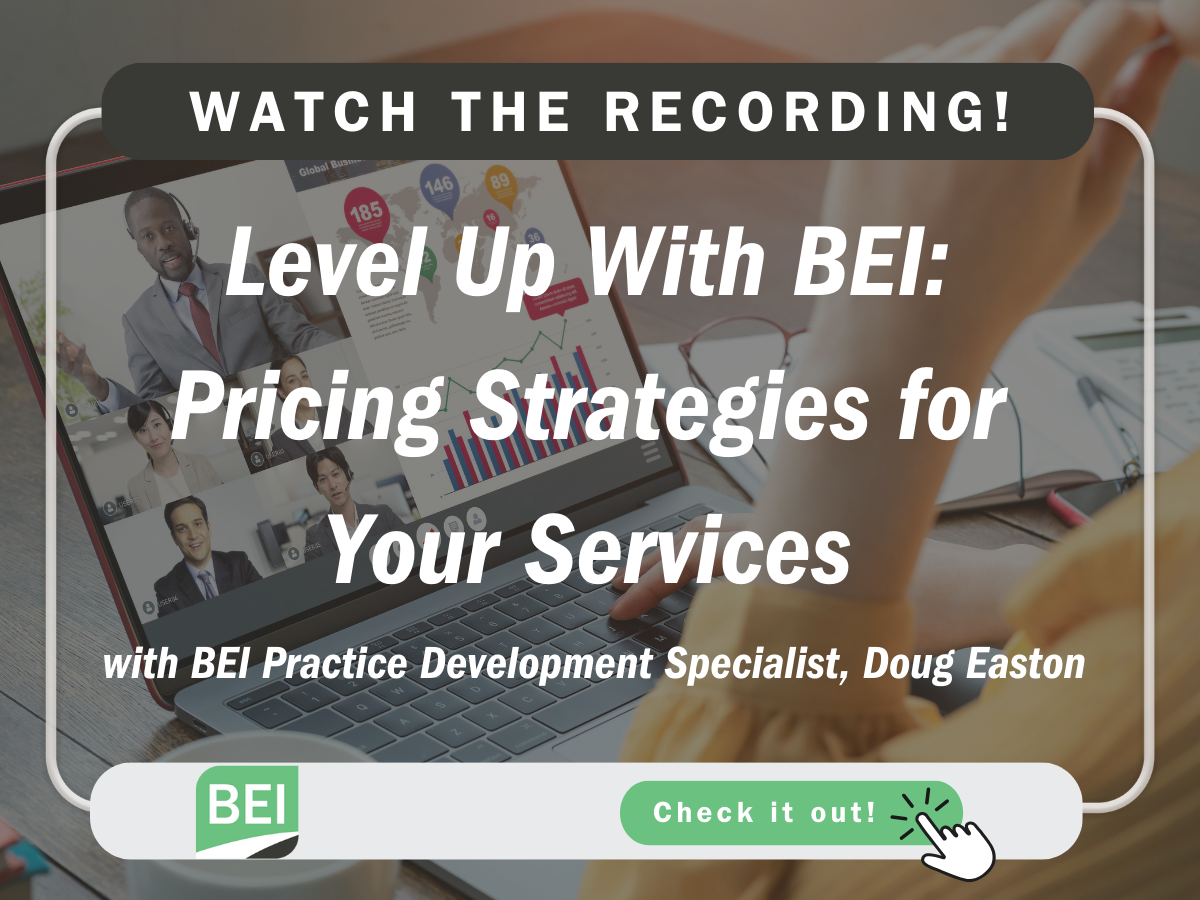
Level Up With BEI: Pricing Strategies for Your Services with BEI Practice Development Specialist, Doug Easton

This presentation hosted by the BEI team was developed to help assist with one of our most asked questions: “How do I charge fees for my planning services?”  

This presentation addresses this common advisor challenge, sharing tools available to determine appropriate fees, how to propose methods to clients, establishing a competitive fee structure, showcasing ROI and more, offering valuable takeaways for advisors in navigating the complexities of pricing.  

Watch the Recording here:

Conclusion

This compilation of the top BEI webinar presentations of 2023 dives into a diverse array of subjects that have shaped the industry and sparked planning conversations throughout the year. From groundbreaking discussions on structured installments and trust planning to insightful analysis of fee structures and owner’s post-exit lives, these webinars have not only showcased the expertise of thought leaders but have also provided crucial takeaways for personal and professional growth. We’d welcome the opportunity to speak with you more about these concepts and how you can use them to get more strategic meetings on the calendar with clients in 2024. 

Be sure to keep an eye on our webinar calendar, as it is frequently being revisited to provide our network with impactful presentations from guests and our team! Check up the lineup for the rest of the year here: https://exitplanning.com/events/  

From Vision to Victory: The Impact of Goals in Exit Planning

In the dynamic landscape of business, the art of Exit Planning emerges as a pivotal skill for entrepreneurs and advisors alike. At the heart of this strategic endeavor lies the power of goal setting, a tool that transcends mere planning and becomes a compass for navigating the uncertain waters of business transitions. 

In our experience assisting business professionals and their clients in sculpting their exit strategies, we’ve identified goal setting as the cornerstone of a successful journey. This post aims to explore the profound impact of clear, actionable goals from the perspectives of both business owners and advisors, highlighting its crucial role in charting the course to Exit Planning success.

The Importance of Setting Goals for Business Owners

Setting goals is an integral part of the Exit Planning Process, serving as more than just a task list. Talking with owners about their goals and objectives has stood as the first step in the Exit Planning framework that BEI has been using since its inception. It’s a strategic maneuver, critical for business owners embarking on this journey.

Establishing Targets: Defining personal, family, and business success criteria helps business owners understand the ‘why’ behind their exit, illuminating the ‘how.’ This clarity propels owners on a path filled with purpose and direction. For instance, a business owner aiming to secure a comfortable retirement or to ensure the business’s legacy continues under new leadership will require the use of different strategies and approaches.

Road Map Creation: A well-defined goal acts as a beacon, guiding business owners through the complexities of Exit Planning. It transforms anxiety into actionable steps, laying out a systematic approach to reach defined objectives. For example, a roadmap might include milestones such as identifying potential buyers, optimizing business value, or developing a succession plan.

Tracking Progress: Goals offer a tangible measure of progress. They help owners gauge where they stand in their exit journey, offering motivation during prosperous times and a re-focus during challenging phases. This could involve regular assessments of business valuation or progress in key areas such as customer diversification or operational improvements.

Resolving Conflicts: Planning for an exit can introduce a variety of conflicts, from family dynamics to differing visions among business partners. Early identification and resolution of these conflicts significantly enhance the likelihood of a harmonious and successful exit.

Enhanced Decision Making: When business owners set clear goals, they are better equipped to make informed decisions. This becomes particularly important in evaluating offers for their business. A clear understanding of their goals allows them to assess whether a potential deal aligns with their objectives, beyond just the financial aspects.

Preparation for Unforeseen Circumstances: The business world is full of uncertainties. Effective goal setting helps owners prepare for unforeseen circumstances, such as market downturns, changes in industry regulations, or unexpected personal events. By having a well-structured Exit Plan, owners can adapt to these changes without losing sight of their end goals.

The Advantages for Advisors in Goal Setting

Advisors play an integral role in the Exit Planning Process, acting as both strategists and facilitators. 

Advisor’s Role: Advisors help shape the Exit Plan to align with the owner’s aspirations, acting as a sounding board and providing strategic insights. Their involvement is instrumental in crafting a tailored exit strategy, ensuring that it resonates with the owner’s personal and business goals.

Building Relationships: Through the goal-setting process, advisors forge deeper relationships with their clients. This evolution from transactional interactions to trusted partnerships is vital, as advisors become indispensable in guiding their clients through the intricacies of Exit Planning.

Team Coordination: Advisors often lead a team of professionals – including CPAs, lawyers, and estate planners – each playing a crucial role in the exit strategy. This coordination fosters trust and cements the advisor’s position as a central figure in the process.

Creating a Comprehensive Approach: Advisors, by understanding the goals of the business owner, can create a comprehensive Exit Plan that addresses all aspects of the transition, including financial, legal, and emotional considerations. This holistic approach ensures that no critical element is overlooked.

Anticipating Challenges and Opportunities: Advisors can use the goal-setting framework to anticipate potential challenges and identify opportunities. For example, understanding the business owner’s timeline for exit can help in strategizing for market conditions or tax implications.

Practical Insights from Surveys and Research

Our most recent survey of business owners revealed a critical insight: while the majority have exit goals, only a fraction have translated these into actionable plans. This gap underscores the need for precise, concrete goals. 

Empirical Evidence of Goal Setting Benefits: Further research into goal setting in business contexts demonstrates that businesses with clearly defined goals show better performance metrics, such as revenue growth and market share expansion, compared to those without clear goals.

Incorporating Flexibility in Goals: While the importance of setting clear, concrete goals is undeniable, it’s equally important to build flexibility into these goals. The business environment is constantly evolving, and goals need to be adaptable to changing circumstances.

Types of Goals in Exit Planning

Exit Planning is diverse, encompassing various goals tailored to individual needs.

Foundational Goals: The primary goal is often securing financial independence. This serves as the financial bedrock for other aspirations, ensuring a stable transition post-exit.

Universal Goals: These revolve around key questions like ‘how much,’ ‘when,’ and ‘to whom.’ Addressing financial needs, timing, and successor planning, these elements are fundamental to any exit strategy.

Values-Based Goals: Values-based goals align the exit strategy with the owner’s ethos and legacy aspirations. These goals add a personal dimension to Exit Planning.

Expanding on Values-Based Goals: Values-based goals often include maintaining company culture, ensuring employee welfare, and contributing to the community. These goals reflect the deeper intentions of the business owner and can significantly influence the choice of successor or the method of exit.

Balancing Short-Term and Long-Term Goals: A successful exit strategy involves balancing short-term objectives with long-term aspirations. While immediate goals may focus on increasing business valuation or streamlining operations, long-term goals could involve maintaining a legacy or ensuring ongoing support for existing staff.

The Bottom Line:

The journey of Exit Planning is nuanced and multifaceted, with goal setting as its core. For business owners and advisors, understanding and implementing this step is crucial for a successful transition. We encourage our readers to embrace this process, starting with defining clear, actionable goals. Connect with us on LinkedIn, Facebook, and Twitter for more insights and updates!

In summary, whether you are a business owner preparing for a future transition, or an advisor assisting in this process, the art of setting clear, well-defined, and adaptable goals cannot be overstated. It’s not just about planning for an exit; it’s about setting the stage for a new beginning that honors past efforts while paving the way for future success.

Maximizing Your Business Story: A Year of Messaging & Marketing Insights from Space Monkey Partners  

In August of 2022, Space Monkey Partners presented at the BEI National Conference, and over the past year, the team at Space Monkey Partners have had the honor of collaborating with Exit Planning Advisors to test and refine strategies for finding, engaging, and converting business owners who require exceptional Exit Planning services. 

Here are some key insights they shared with us from working with several advisors in the BEI Network over the last year: 

Add Personality to Your Messaging

Clients not only want to know what you do but also if they will like you. Our message testing has shown that lead results are the most successful when advisors share their personality with business owners who are contemplating selling their business. Finance is a relational business, and people want to connect, so don’t hesitate to show more about yourself! 

Make the Client the Hero

Although it might seem contradictory to the first learning, making your client the hero in your messaging always fosters stronger relationships. Avoid being the person with a dynamic personality that draws people in, but then only talks about themselves. By focusing your message on solving the customer’s problems, they feel heard, understood, and are more likely to take the desired action. 

It’s Early!

Many business owners are still unaware or don’t understand Exit Planning, so you are dealing with a mostly unaware audience. Embrace the fact that you need to educate them and be patient. We recommend starting with “low hanging fruit,” by targeting those closer to selling (1-2 years away) rather than your ideal clients (5-10 years away). Our top-performing search term was “sell my business,” indicating that those closer to a sale or transition are more willing to take action.

Position Yourself as the Expert to Build Trust

Given longer lead times, you can build trust over time by creating educational content about Exit Planning. Utilize videos, write articles for trade publications, and engage on LinkedIn to stay top of mind. AI-generated content can help get you started, and you can add your personal touch to it. Additionally, considering a BEI Growth or Engagement License designed to help with content creation and distribution is another way to leverage your marketing efforts and increase brand awareness not only about you and your firm, but about the Exit Planning services you provide.

Give Them an Easy Yes

During our tests, we tried various calls to action, including “schedule a consultation,” “take an assessment,” and “download a case study.” The case study required the least commitment but yielded the highest conversion for capturing email addresses. The lower the involvement, the stronger the conversion at this stage.

Build Awareness Together

Consider collaborating on an awareness campaign or advertising venture with BEI and other Members. Pool funds or host a webinar with panelists from different specialties. Together, we can make Exit Planning a norm for all business owners, just as insurance is now a standard practice.

Maximize Your Relationships

Business owners know other business owners. Discover what your clients enjoy doing and invite them to bring a friend along. Overcome your fear of selling and be authentic. Your offerings are valuable, and people will recognize that and want to share it with their friends.

We are grateful for the opportunity to clarify and test messaging with amazing Exit Planning Advisors. We encourage you to continue your exceptional work for your clients, and we’ll keep sharing critical insights for clarifying messaging and generating leads.

Our favorite quote was from Joe Sweeney at Cornerstone Wealth, who told a partner firm:

Walk, Trot, Run, Sprint, Exhaust Yourself to run down Space Monkey. They will, full stop, change your life, save you hundreds of hours with an amazing experience along the way, enjoying the relationship and heart of very special people.”

We feel the same about you, Joe!

If you haven’t fine-tuned your story or want to develop a high-impact, lead generating campaign for your professional practice, feel free to reach out to Keith Lauver at keith@spacemonkey.partners

To learn more about Space Monkey Partners, their work, and how working with BEI Members have provided impactful marketing insights for advisors like you, watch the recording of their recent webinar: